THE CATHOLIC LECTIONARY WEBSITE by Felix Just, S.J., Ph.D.
An Introduction to the Lectionary for Mass
Titles of Different but Related Books:
Bible - all the sacred scriptures of Christianity, arranged in "canonical" order (OT & NT, from Genesis to Revelation)
Lectionary - all the biblical readings used at the Eucharist and other liturgies, arranged in order of the liturgical calendar
Missal - all the texts needed for Mass, including instructions, prayers, readings, some music, etc.
Since Vatican II, the Roman Missal is usually published in two parts: the Sacramentary (texts and prayers spoken by the priest at the altar or presider's chair, but not including the readings) and the Lectionary for Mass (biblical readings proclaimed from the lectern or ambo).
Other Catholic Ritual Books:
Book of the Gospels - more elaborate publications of the Gospel readings from the Lectionary, esp. for use in liturgical processions
Gradual - music and lyrics for sung texts of the Mass, as well as tones for
singing other liturgical texts
Pontifical - texts for ceremonies normally performed only by bishops and popes, such as ordinations and confirmations
Ordos - various publications containing the "Order of Service" (instructions, prayers, biblical readings) for specific rites and sacraments, such as Baptisms, Weddings, Funerals, Anointing of the Sick, Reconciliation/Penance, etc.
Common Lectionary / Revised Common Lectionary - used by most mainline Protestant denominations today;
Sunday edition is very similar to the Catholic Lectionary for Mass; Weekday edition is significantly different
Using More Scripture at Mass was mandated by the Second Vatican Council:
"The treasures of the Bible are to be opened up more lavishly, so that richer fare may be provided for the faithful at the table of God’s word.
In this way a more representative portion of the holy scriptures will be read to the people in the course of a prescribed number of years." (Constitution on the Sacred Liturgy: Sacrosanctum Concilium, #51)
Roman Missal / Missale Romanum (various pre-Vatican II editions, based on the one of Pope Pius V from 1570)
same readings were used year after year, on the same Sundays and feast days
most Masses had only two readings: one called "The Epistle" and the other "The Gospel"
readings were rarely from the OT, only on a few feasts, vigils, ember days, and within some liturgical octaves
most weekday Masses did not have proper readings, but used readings from the prior Sunday or a saint's day.
total biblical texts used for Sundays, vigils, and major feasts included only about
22% of the NT Gospels, 11% of the NT Epistles, and only 0.8% of the OT (not counting the Psalms).
Lectionary for Mass, first edition (revision mandated by the Second Vatican Council, 1963)
Latin edition 1969; USA edition 1970; use began on the First Sunday of Advent: Nov. 30, 1970
three readings are now prescribed for Sundays & major feasts: 1) usually OT books, 2) NT Epistles, 3) NT Gospel
there is a much greater variety of readings: 3-year Sunday rotation: Cycles A/B/C; 2-year weekday cycle: Years I/II
total biblical texts used for Sundays, vigils, and major feasts now include about
58% of the NT Gospels, 25% of the NT Epistles, but still only 3.7% of the OT (aside from the Psalms).
Lectionary for Mass, second edition (second post-Vatican II editions)
Latin edition, 1981 - based on the Neo-Vulgate Bible translation
Canadian edition, 1992 - based on the NRSV translation (inclusive language dispute)
USA edition: Sundays 1998, Weekdays 2002 - based mostly on the NAB translation
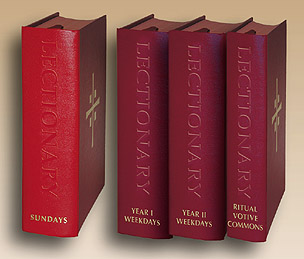
Publication of the current USA edition is normally in four volumes:
Sundays and Major Feast Days - Years/Cycles A, B, C
Weekdays, Year I - odd-numbered years, incl. feasts of saints with "proper" readings
Weekdays, Year II - even-numbered years, incl. feasts of saints with "proper" readings
Common of Saints, Rituals, Votives, Various Needs - many more choices of readings than before
The Lectionary for Mass now covers much of the NT (about 90% of the Gospels, 55% of the rest: Acts,
Epistles, Revelation),
and much more of the OT than before Vatican II (about 13%);
the fact that we don't include much more of the OT is understandable, given how much longer the OT is and the contents of some of the longer books.
Bible Translations used in the Lectionaries of English-Speaking Countries:
JB: Jerusalem Bible – Australia, England/Scotland/Wales, Ireland, India (option), New Zealand, Pakistan, South Africa
RSV: Revised Standard Version – India (option)
RSV-CE: Revised Standard Version, 2nd Catholic edition – Antilles
NRSV: New Revised Standard Version – Canada; under consideration for Australia, England/ Scotland/Wales, Ireland
NAB: New American Bible (2nd ed.) – United States, Philippines
Masses for Sundays and Major Feast Days: Three Readings - really five!
First Reading - from the Old Testament; except from Acts of the Apostles during Easter Season
Responsorial Psalm - mostly from the Book of Psalms; sometimes other biblical "Canticles"
Second Reading - mostly from the Letters of Paul, but sometimes other NT Epistles and the Book of Revelation
Verse before the Gospel - usually a direct biblical quotation, but sometimes adapted from a biblical text
Gospel - Year A: Matthew; Year B: Mark mostly; Year C: Luke; (where's John? used mostly in Lent & Easter)
Masses for Weekdays, Lesser Feasts, and Special Occasions: Two Readings - really four!
First Reading - semi-continuous readings; alternate between OT & NT; on a two-year cycle
Responsorial Psalm - mostly from the Book of Psalms, but sometimes other Canticles; also on a two-year cycle
Verse before the Gospel - first edition had mostly "common" texts; now specifically prescribed texts
Gospel - same each year; semi-continuous readings from Mark, Matthew, Luke, in that order
Readings for Special Masses and Liturgies:
Saints - four categories, in decreasing order of importance: Solemnities, Feasts, Memorials, Optional Memorials
some saints have their own "Propers" - prayers and readings specifically selected for the particular saint
for other feast days, texts and prayers are recommended from various "Commons" - Anniversary of the Dedication of a Church, Blessed Virgin Mary, Martyrs, Pastors, Doctors of the Church, Virgins, and Holy Men & Women
Ritual Masses - incl. Christian Initiation (of adults or children; baptism, confirmation, and first communion), Conferral of Holy Orders and other Ministries, Pastoral Care of the Sick and Dying, Sacrament of Marriage, Religious Profession, Blessing of a Church or Altar, etc.
Masses for Various Occasions - four subcategories:
for the Holy Church (incl. pope, pastoral meetings, unity of Christians, etc.),
for Public Needs (civil leaders, peace and justice, in time of war, etc.),
in Various Public Circumstances (new year, harvest, refugees, natural disasters, etc.),
and for Various Needs (promotion of charity, for the family, for a happy death, etc.)
Votive Masses - Holy Trinity, Holy Cross, Holy Eucharist, Christ the High Priest, Holy Name of Jesus, Precious Blood, Sacred Heart, Blessed Virgin Mary, St. Joseph, All the Holy Apostles, Sts. Peter & Paul, St. Peter, St. Paul, One Holy Apostle, All the Saints
Masses for the Dead - incl. Funeral Liturgies and Memorial Masses, Funerals for Baptized Children, and Funerals for Children who Died before Baptism
Concluding Notes:
There is normally an intentional thematic connection between the Gospel & the First Reading (usually also the Resp. Psalm & Gospel Accl.); but the Second Reading is usually unrelated, since it follows a separate semi-continuous reading pattern.
If one includes all the Masses for Sundays, Solemnities, feasts, weekdays, rituals, votives, the propers and commons of saints, and special needs and occasions, the Lectionary for Mass now covers much of the NT (about 90% of the Gospels, 55% of the rest: Acts,
Epistles, Revelation), but still very little of the OT (slightly over 13%), but this is understandable, given how much longer the OT is.
 Titles of Different but Related Books:
 Lectionary for Mass, second edition (second post-Vatican II editions)