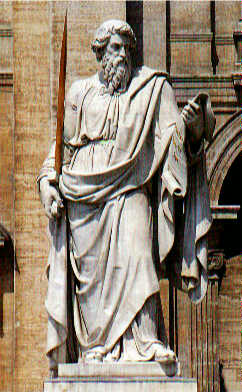
Luke’s Prologue: Recapitulating the End of His Gospel (1:1-14)
Address to Theophilus, summarizing Luke’s first book (1:1-3)
The risen Jesus’ final appearance to the disciples, and his ascension into heaven (1:4-11)
Jesus’ disciples and family remain in Jerusalem to await the coming of the Spirit (1:12-14)
The Early Days of the Community of Believers in Jerusalem (1:15–8:3)
To replace Judas, another apostle is chosen: Matthias (1:15-26)
The coming of the Spirit on the day of Pentecost (2:1-13)
Peter preaches to the crowd in Jerusalem; in response, thousands are baptized (2:14-41)
The communal life of the first believers, including the Breaking of the Bread (2:42-47)
Peter and John heal a crippled beggar near the temple (3:1-10)
Peter preaches to the crowd amazed by this miracle (3:11-26)
Peter and John are arrested and give witness before the Sanhedrin (4:1-22)
After Peter and John are released, the community prays together (4:23-31)
The believers share everything in common, with two examples of sharing possessions:
one positive (Joseph/Barnabas) and one negative (Ananais & Sapphira; 4:32–5:11)
The apostles perform many miracles, healing and converting many people (5:12-16)
They are again arrested, miraculously freed from prison; they testify to the Sanhedrin (5:17-42)
Seven Hellenists are appointed as community servants/deacons (6:1-7)
The deacon Stephen is arrested, put on trial, preaches fearlessly, (6:8–7:53)
Stephen is stoned to death, praying for forgiveness for his persecutors (7:54-60)
A persecution begins against the church, conducted especially by Saul (8:1-3)
The Good News about Jesus Spreads throughout Judea and Samaria (8:4–12:25)
Philip preaches in Samaria; the apostles Peter and John confront Simon the Magician (8:4-25)
Philip encounters the Ethiopian eunuch on the road to Gaza (8:26-40)
The risen Jesus appears to Saul (Paul) on the road to Damascus (9:1-9)
Saul meets Ananias, is baptized, begins preaching about Jesus, and flees the city (9:10-25)
Saul goes to Jerusalem, meets Barnabas and the apostles; then goes off to Tarsus (9:26-30)
The Church grows; Peter heals a paralytic in Lydda and raises a dead girl in Joppa (9:31-43)
Cornelius, a Roman centurion, is converted by Peter; the Spirit is given to Gentiles (10:1-48)
Peter explains to believers in Jerusalem why he baptized Gentiles (11:1-18)
The community of disciples at Antioch are the first to be called “Christians” (11:19-26)
Agabus predicts a famine, so the Antioch church sends relief to believers in Judea (11:27-30)
James, son of Zebedee, is martyred; Peter is arrested but then delivered from prison (12:1-19)
King Herod (Agrippa I) dies (12:20-23); the church continues to grow (12:24-25)
Barnabas and Paul (Saul) Are Sent Out by the Church at Antioch (13:1–14:28)
The Church at Antioch commissions Barnabas and Saul (Paul) as missionaries (13:1-3)
Barnabas and Saul/Paul preach on the island of Cyprus, incl. before the proconsul (13:4-12)
They move on to Perga in Pamphylia and Antioch in Pisidia (South-central Turkey; 13:13-52)
They briefly preach in Iconium, but are attacked and flee to Lycaonia (14:1-7)
Paul and Barnabas heal a cripple and preach at Lystra, and also in Derbe (14:8-20)
They retrace their steps, visiting all the churches, and return to Antioch in Syria (14:21-28)
The COUNCIL of JERUSALEM: Requirements for Gentile Christian Converts (15:1-35)
A crucial question arises: Do Gentiles need to be circumcised? (15:1-5)
The apostles and elders meet in Jerusalem and debate the issues (15:6-21)
They write a letter to communicate their decision to the church of Antioch (15:22-35)
The Mission of Paul and His Companions in Greece and Asia Minor (15:36–20:38)
Barnabas and Paul separate, each taking new companions on their missions (15:36-41)
Paul, Silas, and Timothy travel through Lycaonia and Asia Minor to Macedonia (16:1-12)
At Philippi they baptize Lydia, exorcise a demon, are arrested, but delivered from prison (16:13-40)
Paul and his companions preach and face danger in Thessalonica (17:1-9)
Paul and Silas flee to Beroea, where they preach, but again encounter opposition (17:10-15)
Paul is taken to Athens, where he preaches at the Areopagus (17:16-34)
Paul moves on to Corinth, establishes a church, and is tried before the proconsul Gallio (18:1-17)
Paul travels back ot the East, briefly visiting the churches at Jerusalem and Antioch (18:18-23)
Meanwhile, Apollos preaches about Jesus in Ephesus and Corinth (18:24-28)
Paul settles in Ephesus over two years, preaching, doing miracles, and building up the church (19:1-22)
Silversmiths in Ephesus riot and persecute Paul’s companions; but the city clerk intervenes (19:23-41)
On their way to Jerusalem, Paul and his companions revisit the churches of Greece and Asia Minor;
at Troas he raises Eutychus back to life; at Miletus he speaks with the elders from Ephesus (20:1-38)
Paul Returns to Jerusalem and Is Imprisoned in Caesarea (21:1–26:32)
Paul journeys toward Jerusalem; his destiny is foretold by the prophet Agabus (21:1-14)
Paul arrives in Jerusalem, visits the temple, causes a riot, and is arrested (21:15-40)
Paul defends himself before a crowd in Jerusalem, and is interrogated by the Roman tribune (22:1-29)
Paul defends himself before the Sanhedrin in Jerusalem (22:30–23:11)
Paul’s life is threatened, so he is taken to the Roman governor in Caesarea (23:12-35)
Paul defends himself on trial before the governor Felix (24:1-27)
Paul defends himself before the governor Festus and appeals to Caesar (25:1-12)
Paul is presented to King Agrippa and Queen Bernice, who listen to his defense (25:13–26:32)
Paul Is Taken as a Prisoner to Rome (27:1–28:16)
Paul and other prisoners begin the long sea voyage towards Rome, stopping at Crete (27:1-12)
A storm at sea causes their ship to drift and eventually wreck on the island of Malta (27:13-44)
The prisoners winter on Malta, where Paul performs various miracles and healings (28:1-10)
They continue their journey to Sicily and Italy, and finally arrive at Rome (28:11-16)
Paul Lives in Rome and Continues Preaching (28:17-31)
Paul meets the Jewish leaders in Rome and preaches to them about Jesus (28:17-29)
Luke's Conclusion: Paul continues preaching and teaching in Rome for two years (28:30-31)
The Acts of the Apostles does not contain a complete history of the growth and expansion of Christianity in its first generation, but focuses only on a few missionaries active in a few geographical areas. Its selections are theologically driven, not historically comprehensive.
Acts begins in Jerusalem, the capital of Israel (1:4)
and ends in Rome, the capital of the whole empire (28:14b-31).
Luke's Gospel begins and ends in Jerusalem, and focuses (more than Mark or Matthew do) on the activities of Jesus in Jerusalem, Jericho, and the other cities and larger towns of Palestine.
Similarly, the main focus of Acts is on the activities of the Christian missionaries and communities in Jerusalem, Antioch, Corinth, Ephesus, other provincial capitals, and several other larger cities of the early Roman Empire.
In other words, the author Luke is basically a "big city person" who shows little interest in small towns or rural areas.
Acts 1:8 seems to give a geographical outline of the whole book, as Jesus tells his apostles, "But you will receive power when the Holy Spirit has come upon you; and you will be my witnesses in Jerusalem, in all Judea and Samaria, and to the ends of the earth."
Acts 17 describes the preaching of the apostles and the growth of the Christian community in Jerusalem.
Acts 812 focuses mainly on the spread of the church to other parts of Judea and Samaria (and nearby Syria).
Acts 1328 deals with the expansion of Christianity to "the ends of the earth," esp. through Asia Minor, Greece, and eventually to Rome, the capital and largest city of the Roman empire.
See my page on New Testament Geography page for descriptions and maps of most of these places.
The Role of the Holy Spirit:
Just as in Luke's Gospel, the Spirit of God inspires and guides most of the action within the Acts of the Apostles. Some scholars even suggest that this book could better be called "The Acts of the Holy Spirit":
A whole series of speeches and sermons delivered by the apostles in various contexts (esp. by Peter or Paul) summarize the essence of the early Christian preaching about Jesus:
2:14-41 – Peter preaches to the crowds who gathered in Jerusalem on the day of Pentecost
3:12-26 – Peter addresses the people in the Temple Court who had seen him and John cure a crippled beggar
4:8-12 – Peter and John speak about Jesus fearlessly when questioned by the Sanhedrin
5:29-32 – Peter and the apostles again give witness about Jesus before the Sanhedrin
7:2-53 – Stephen delivers a long sermon/defense to the Sanhedrin after he is accused of blasphemy
8:26-38 – Philip preaches to the Ethiopian eunuch traveling on the road from Jerusalem down to Gaza
10:35-49 – Peter preaches in Caesarea to the household of Cornelius, a Roman centurion
13:16-41 – Barnabas and Paul preach to the congregation assembled in the synagogue at Antioch in Pisidia
16:30-34 – After being delivered from prison, Paul and Silas preach to their jailer and his family in Philippi
17:22-34 – Paul speaks rather philosophically to the people of Athens at the Areopagus
19:1-7 – Paul preaches about the Holy Spirit to some believers at Ephesus
20:17-35 – Paul gives a farewell speech at Miletus to the elders visiting from the Church of Ephesus
22:1-21 – Paul defends himself and his mission to a crowd of Jews in Jerusalem
23:1-6 – Paul defends himself before the Sanhedrin in Jerusalem
24:10-21 – Paul defends himself before the governor Felix in Caesarea
26:1-23 – Paul later defends himself before King Agrippa and Queen Bernice in Caesarea
28:23-28 – Paul preaches to some Jews in Rome
Each of these sermons and speeches include many, if not all, of the following key points:

Jesus of Nazareth is the Messiah, the Christ, sent by God,
as promised in the Scriptures, as foretold by the prophets,
for the forgiveness of sins, for the salvation of the world;
He was rejected by the people, condemned by the authorities;
he suffered, was crucified, died, and was buried.
Yet God exalted him on high, raised him up to new life;
and he will one day return to us in glory.
In response, people must repent, believe, be baptized,
receive the Holy Spirit and join the community of believers.
The Community Life of the First Disciples:
Several passages early in Acts summarize the most important features of the community life of the early believers in Jerusalem:
After Peter preaches to the crowd on the day of Pentecost, a large number become believers and are baptized. About these people the narrator says,
"They devoted themselves to the apostles' teaching and fellowship, to the breaking of bread and the prayers" (Acts 2:42).
The narrator immediately adds a more extended description of the community of believers:
"Awe came upon everyone, because many wonders and signs were being done by the apostles. / All who believed were together and had all things in common; / they would sell their possessions and goods and distribute the proceeds to all, as any had need. / Day by day, as they spent much time together in the temple, they broke bread at home and ate their food with glad and generous hearts, / praising God and having the goodwill of all the people. And day by day the Lord added to their number those who were being saved." (Acts 2:43-47)
Scholars see these as four key characteristics of the early Christian communal life:
apostolic teaching: not only the explicit preaching and teaching with words, but also through the examples and actions of the apostles
community fellowship: sharing of possessions, caring for the needs of the poor, holding all things "in common"
breaking of the bread: a ritual meal celebrated in their homes to signify their unity and remember Jesus' Last Supper
worship and prayer: continuing the Jewish practices and traditions of public prayer in the Temple and with their families
A few chapters later, the narrator tells us even more about how they shared all their property (Acts 4:32-35):
"Now the whole group of those who believed were of one heart and soul, and no one claimed private ownership of any possessions, but everything they owned was held in common. / With great power the apostles gave their testimony to the resurrection of the Lord Jesus, and great grace was upon them all. / There was not a needy person among them, for as many as owned lands or houses sold them and brought the proceeds of what was sold. / They laid it at the apostles' feet, and it was distributed to each as any had need."
Two examples are then given, one positive and one negative, of people sharing or withholding their goods (Acts 4:36–5:11):
Barnabas, a Levite from Cyprus, sells some property and gives the proceeds to the apostles (4:36-37).
Ananias and Sapphira, a married couple, sell some property, but lie to the community and are punished by God (5:1-11).
Parallels between the Apostles and Jesus:
The portrayal of the apostles in Acts is very similar to the portrait of Jesus in Luke's Gospel. Just like Jesus, the apostles are filled with the Holy Spirit, they quote from the scriptures in their preaching, they teach and heal, they perform miracles and exorcisms, they gain followers but also stir up opponents, they are persecuted and some of them are arrested, but they forgive their opponents and remain faithful to God even if they are killed:
The Apostles in Acts
Jesus in Luke's Gospel
The Holy Spirit descends on the apostles at Pentecost (2:1-4)
The Holy Spirit descends on Jesus at his baptism (3:21-22)
Peter preaches, quoting from the prophet Joel (2:16-36; quoting Joel 2:28-32)
Jesus preaches, after reading from the prophet Isaiah (4:14-30; quoting Isa 61:1-2)
The apostles call people to join them (2:37-41, 47b)
Jesus calls his first followers (5:1-11, 27-32)
Peter and John heal a lame beggar (3:1-10)
Jesus heals a blind beggar (18:35-43)
The high priest arrests several apostles and questions them before the council (4:1-22)
Jesus is arrested and interrogated by the council (22:47-71)
The narrator summarizes the "signs and wonders" of the apostles,
especially their healings and exorcisms (5:12-16; 8:6-7, 13)
The narrator summarizes the miraculous activity of Jesus,
esp. his healings and exorcisms (4:40-41; 6:17-19)
The sick are healed through Peter's shadow (5:15) and Paul's handkerchiefs (19:11-12)
A woman is healed when she touches the fringes of Jesus' clothing (8:43-48)
The Jewish leaders want to kill the apostles, because of their teachings (5:17-42)
Jewish leaders plot to kill Jesus, partly due to his teachings (19:45-48)
Peter raises Tabitha (a.k.a. Dorcas) from the dead at Joppa (9:36-42)
Jesus raises a widow's son from the dead at Nain(7:11-17)
The apostles encounter a pious Roman centurion (10:1-48)
Jesus heals the son of a faithful Roman centurion (7:1-10)
Paul feels compelled by the Spirit to go to Jerusalem,
despite the dangers that await him there (19:21; 21:8-17)
Jesus is determined to go to Jerusalem,
despite the dangers that await him there (9:51; 13:33; 19:11-28)
Paul is welcomed in Jerusalem by the believers, and soon goes to the temple (21:17-26)
Jesus is welcomed in Jerusalem by large crowds, and soon goes to the temple (19:28-48)
Paul is seized by a Jewish mob that wants him killed,
but later stands trial before Roman governors (21:30-36; 23:2326:32)
Jesus is arrested by a Jewish mob,
but is later turned over to the Roman procurator for trial (22:47-54; 23:1-25)
Paul argues against the Sadducees, who do not believe in the resurrection (23:6-9)
Jesus is questioned by some Sadducees, who deny the concept of resurrection (20:29-38)
Paul takes bread, gives thanks, breaks it, and eats (27:35; cf. 20:7-11)
Jesus takes bread, blesses it, breaks it, and gives it to
his disciples to eat (27:35; cf. 24:30)
As he is being stoned to death, Stephen hands his spirit over to the Lord Jesus
and forgives his executioners (7:59-60)
As he is dying on the cross, Jesus forgives his executioners
and hands his spirit over to God (23:34, 46)
Parallels between Peter and Paul:
Not only are the words and actions of all the apostles shown to be similar to those of Jesus, but the portrayals of the apostles Peter and Paul are similar in many significant respects in the Acts of the Apostles:
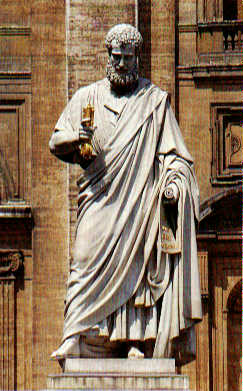
Roughly the first half (Acts 1-12), dealing with the beginnings of the Church in and around Jerusalem, focuses on the leadership of Peter (and John), while the second half (Acts 13-28), dealing with the expansion of the Church into non-Jewish areas of the Roman Empire, focuses on the activities of (Barnabas and) Paul; but there is some overlap between these apostles:
Paul (still named Saul before 13:9) is introduced as early as 7:58, and also mentioned in 8:1-3; 9:1-30; 11:25-30.
Peter (also called Simon in 10:17-18, 32 and Simeon in 15:14) is still a key player in the "Council of Jerusalem" (15:1-35), although the leadership of James in the Jerusalem church is already evident by this time (15:13-21; cf. 21:18).
Although in his Letter to the Romans, Paul calls himself "an apostle to the Gentiles" (Rom 11:13), while he calls Peter "an apostle to the circumcised" (Rom 2:8), in the Acts of the Apostles both Peter and Paul are portrayed as converting both Jews and Gentiles:
Peter preaches mainly to Jews, but is also involved in the conversion of some Samaritans (Acts 8:14-25) and of Cornelius, a Roman centurion (10:111:1-18).
Paul works mainly among Gentiles, but normally begins in a new town by preaching in the local synagogue to his fellow Jews (Acts 13:5, 14, 44; 14:1; 17:1; 18:4; etc.).
Both Peter and Paul do many of the same actions and encounter many of the same problems throughout Acts:
Parallel Action
Peter [in Acts 212]
Paul [in Acts 1328]
They both function as witnesses to the risen Christ
1:21-22
23:11; 26:16
The Holy Spirit initiates and guides their actions
2:1-40
13:1-40
Both heal people who are lame or unable to speak
3:12-26
13:1-40
Both are defended by Pharisees in the Sanhedrin
5:34-39
23:9
Both appoint other leaders with prayer and laying on hands
6:1-6
14:23
Their persecution (stoning) leads to broadening the mission
[6:88:4, Stephen]
14:19-23
Both are accused of acting against Moses
[6:13-14, Stephen]
21:20-21; 25:8
Both encounter and confront a magician
8:9-24
13:6-12
Both bestow the Spirit through the laying on of hands
8:14-17
19:1-6
Both raise a dead person back to life
9:36-43
20:9-12
Some Gentiles try to worship them
10:25-26
14:13-15
In Jerusalem, they defend the mission to Gentiles
11:1-18
21:15-40
Both are imprisoned at a Jewish feast
12:4-7
21:16-28
Both are delivered from prison
12:6-11
16:24-26
Conclusion: The word of God continues to spread
12:24
28:30-31
(based on Pheme Perkins, Reading the New Testament, pp. 264)
Brown, Raymond E. An Introduction to the New Testament. New York: Doubleday, 1997. - "The Acts of the Apostles" (pp. 279-332).
Barrett, C. K. A Critical and Exegetical Commentary on the Acts of the Apostles. International Critical Commentary. 2 vols. Edinburgh, Scotland: T&T Clark, 1994-98.
Bruce, F. F. The Acts of the Apostles. New International Commentary on the NT. 2nd ed. Grand Rapids: Eerdmans, 1988.
Haenchen, Ernst. The Acts of the Apostles. Philadelphia: Westminster, 1971.
Johnson, Luke Timothy. The Acts of the Apostles. Sacra Pagina 5. Collegeville, MN: Liturgical Press, 1992.