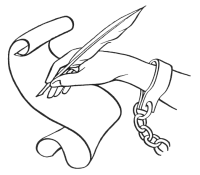
So pseudepigraphy = “false attribution of authorship” or “falsely attributing a writing to someone different from the actual author.”
A pseudepigraphic work is composed as if it were written by a person from the past (the “attributed author”), while the actual author was someone else (usually anonymous).
The attributed author is usually either a famous person from the remote past, or the actual author’s own teacher (after his death).
These should not be called “false writings”; pseudepigraphy says nothing about the value of the work's content, but merely about the attributed authorship.
These are also different from “pseudonymous” works (“pseudonym” = “false name”), in which an author uses a fictitious name to conceal his/her own identity.
Pseudepigraphy was a commonly accepted practice in the ancient world, unless it was recognized as a deliberate deception.
In modern understanding it would be considered “creative writing” at best, or “plagiarism” or “forgery” at worst.
Our modern emphasis on “historical accuracy” leads us to ask: Who actually wrote this work? Who was the main or final author?
The ancient world had a broader sense of “authorship,” involving many more people in oral and written stages over the course of time.
Purpose: Why was it done?
Cultural presupposition in ancient/biblical times: old is good, so the older the better; anything new is questionable or suspect.
This contrasts strongly with our modern mentality: new is good, so the newer the better; old things are defunct or worthless.
So if an ancient author claimed something was “brand new” or an “original idea,” few people would pay attention.
But if he passed on what his teacher said (who had learned it from even earlier teachers), then more people would be interested.
Writing in the name of a famous personage or authoritative teacher stresses the unity of the later “actual author” with the earlier “attributed author.”
It also stressed continuity, by carrying a tradition forward and adapting/applying it to new historical circumstances.
Examples:
A large collection of “Letters of Socrates” were composed as if written by Socrates himself (5th century BC);
but they actually originated in the first century AD, as a way for philosophers of the Roman era to continue and adapt the teachings of that ancient Greek philosophical master.
The “Old Testament Pseudepigrapha” includes dozens of works attributed to such biblical characters as Enoch, Isaiah, Ezra, Baruch, etc.;
but they were actually composed between about 200 BC and 200 AD, many centuries after these characters lived.
The “New Testament Apocrypha” includes dozens of writings (Gospels, Acts, Epistles, etc.) attributed to the first apostles of Jesus;
but they were actually written several decades or centuries later, either by the followers of the apostles or by later generations of Christians.
Letters attributed to St. Paul:
Of the thirteen NT letters attributed to Paul, most scholars today distinguish between two groups: those written by Paul himself vs. those written by his followers. However, since not all scholars are in agreement regarding the authorship of certain letters, rather than calling the two groups the “true” letters vs. the “false” ones, it is better to distinguish between the “undisputed” letters vs. the “disputed” ones.
The seven “Undisputed Letters” (a.k.a. the “Authentic Pauline Letters”).
These can be put into three subgroups chronologically:
About 95-99% of scholars today agree that all of these letters were actually written by Paul himself.
The six “Disputed Letters” (a.k.a. the “Deutero-Pauline Epistles”).
For two of these, the scholarly divide is about 50/50 (that is, about 50% of scholars think they were written by Paul himself, while the other 50% think
they are “pseudepigraphic” or written later by a follower of Paul):
If 2 Thessalonians is authentic, Paul probably wrote it soon after 1 Thess (in order to correct some misunderstandings caused by 1 Thess itself), since it is so similar in form and content to 1 Thess.
If Colossians is authentic, Paul probably wrote it near the end of his life (after spending several years in prison), since the theology expressed in it is rather different from Paul's earlier letters.
If either or both of these letters are pseudepigraphic, then they were probably written in the last few decades of the first Christian century.
For the other four letters, about 80% of scholars think they were not written by Paul himself, but by one of his followers after his death:
Ephesians is almost definitely a later expansion of Colossians, since they are so similar in structure and theology, but quite different from Paul's earlier letters; Ephesians was probably written to serve as a “cover letter” for an early collection of Pauline letters.
The Pastoral Epistles (1 Timothy, 2 Timothy, Titus) were most likely written late in the first century by some member(s) of the “Pauline School” who wanted to adapt his teachings to changing circumstances.
Note: Judging a particular letter to be pseudepigraphic does not mean that it is any less valuable than the other letters, but only that it was written later
by someone other than Paul.
All thirteen of the letters attributed to Paul are still considered “canonical”; all of them are still part of the Holy Bible and foundational for the Christian Church.
Distinguishing the letters based on actual authorship, however, allows scholars to see more clearly the development of early Christian theology and practice.
The so-called Epistle to the Hebrewsis definitely not written by Paul, and is not even explicitly attributed to him.
For centuries, many Christians counted it as the fourteenth work in the Pauline corpus, mainly because the epistolary ending mentions Timothy, Paul's closest associate (see Heb 13:23).
However, contrary to all other letters and epistles, the opening of Hebrews does not name its author at all.
In literary genre, therefore, Hebrews is not really a “letter”; rather, it is a “homily” (a scripture-based sermon).
Note: Click on the Letter Titles hyperlinked above to go to separate webpages devoted to the various letters.