The Feeding of the Multitudes, the Last Supper, the Lord's Supper, and the Eucharist
by Felix Just, S.J., Ph.D.
The various New Testament accounts of Jesus feeding the multitudes, the Last Supper of Jesus with his disciples, and the Early Christian Church's commemoration of the Lord's Supper (also called the "Breaking of the Bread" or later the "Eucharist" ), contain similar patterns of four key verbs (or their synonyms):
The Feeding of the 5000 (in all four Gospels):
Mark 6:41 - "Taking the five loaves and the two fish, he looked up to heaven,
and blessed and broke the loaves, and gave them to his disciples to set before the people;
and he divided the two fish among them all."
Matt 14:19 - "Taking the five loaves and the two fish, he looked up to heaven,
and blessed and broke the loaves, and gave them to the disciples,
and the disciples gave them to the crowds."
Luke 9:16 - "And taking the five loaves and the two fish, he looked up to heaven,
and blessed and broke them, and gave them to the disciples to set before the crowd."
John 6:11 - "Then Jesus took the loaves,
and when he had given thanks, he distributed them to those who were seated;
so also the fish, as much as they wanted."
The Feeding of the 4000 (only in Mark and Matthew, not Luke or John):
Mark 8:6 - "...and he took the seven loaves,
and after giving thanks he broke them and gave them to his disciples to distribute;
and they distributed them to the crowd."
Matt 15:36 - "...he took the seven loaves and the fish;
and after giving thanks he broke them and gave them to the disciples,
and the disciples gave them to the crowds."
The Last Supper (as narrated in the Synoptic Gospels and mentioned by Paul; but very different in John's Gospel):
Mark 14:22-24 - "While they were eating, he (Jesus) took a loaf of bread,
and after blessing it he broke it, gave it to them,
and said, 'Take; this is MY BODY.'
Then he took a cup, and after giving thanks he gave it to them, and all of them drank from it.
He said to them, 'This is MY BLOOD of the covenant, which is poured out for many.' "
Matt 26:26-28 - "While they were eating, Jesus took a loaf of bread,
and after blessing it he broke it, gave it to the disciples,
and said, 'Take, eat; this is MY BODY.'
Then he took a cup, and after giving thanks he gave it to them, saying, 'Drink from it, all of you;
for this is MY BLOOD of the covenant, which is poured out for many for the forgiveness of sins.' "
Luke 22:17, 19-20 - "Then he took a cup, and after giving thanks he said, 'Take this and divide it among yourselves;...'
Then he took a loaf of bread,
and when he had given thanks, he broke it and gave it to them,
saying, 'This is MY BODY, which is given for you. Do this in remembrance of me.'
And he did the same with the cup after supper,
saying, 'This cup that is poured out for you is the new covenant in MY BLOOD.' "
1 Cor 11:23-26 - "For I (Paul) received from the Lord what I also handed on to you,
that the Lord Jesus on the night when he was betrayed took a loaf of bread,
and when he had given thanks, he broke it
and said, 'This is MY BODY that is for you. Do this in remembrance of me.'
In the same way he took the cup also, after supper,
saying, 'This cup is the new covenant in MY BLOOD. Do this, as often as you drink it, in remembrance of me.'
For as often as you eat this bread and drink the cup, you proclaim the Lord's death until he comes."
John 13:1-30 - The above "words of institution" are not narrated in John, but replaced with the story of Jesus washing his disciples' feet. Yet the setting is clearly Jesus' last meal before his death, as mentioned in vv. 4, 12, and 26-30. The "Eucharistic teaching" of John's Gospel is found earlier, at the end of the "Bread of Life Discourse" (6:22-59; see below)
The Supper at Emmaus (only in Luke):
Luke 24:30-31, 33, 35 - "When he was at table with them, he took bread,
blessed it, and broke it, and gave it to them.
Then their eyes were opened, and they recognized him; and he vanished from their sight...
That same hour they got up and returned to Jerusalem;
and they found the eleven and their companions gathered together...
Then they told what had happened on the road,
and how he had been made known to them in the breaking of the bread."
Two of St. Paul's Meals:
Acts 20:7, 11 - "On the first day of the week, when we met to break bread,
Paul was holding a discussion with them; since he intended to leave the next day, he continued speaking until midnight...
Then Paul went upstairs, and after he had broken bread and eaten, he continued to converse with them until dawn; then he left."
Acts 27:35 (Paul speaks to everyone on a ship after fourteen days of riding out a storm at sea) -
"After he had said this, he took bread; and giving thanks to God in the presence of all, he broke it and began to eat."
More on Early Christian "Breaking of Bread" (a.k.a. Lord's Supper or Eucharist):
1 Cor 10:16-17 - "The cup of blessing that we bless, is it not a sharing in the BLOOD of Christ? The bread that we break, is it not a sharing in the BODY of Christ?
Because there is one bread, we who are many are one body, for we all partake of the one bread."
1 Cor 11:17-21 (Paul scolding the early Christians in Corinth for not conducting the Lord's Supper properly) -
"...when you come together it is not for the better but for the worse. For, to begin with,
when you come together as a church, I hear that there are divisions among you...
When you come together, it is not really to eat the Lord's supper.
For when the time comes to eat, each of you goes ahead with your own supper,
and one goes hungry and another becomes drunk." (see also 11:23-34)
Acts 2:42, 46 - "They (the community of believers in Jerusalem) devoted themselves to the apostles' teaching and fellowship,
to the breaking of breadand the prayers... Day by day, as they spent much time together in the temple,
they broke bread at home and ate their food with glad and generous hearts..."
John 6:35, 47-58 (the Johannine teaching about the Eucharist is found at the end of the "Bread of Life Discourse") -
Jesus said to them, "I am the bread of life. Whoever comes to me will never be hungry, and whoever believes in me will never be thirsty...
Very truly, I tell you, whoever believes has eternal life. I am the bread of life. Your ancestors ate the manna in the wilderness, and they died.
This is the bread that comes down from heaven, so that one may eat of it and not die. I am the living bread that came down from heaven.
Whoever eats of this bread will live forever; and the bread that I will give for the life of the world is my flesh."
The Jews then disputed among themselves, saying, "How can this man give us his flesh to eat?"
So Jesus said to them, "Very truly, I tell you, unless you eat the flesh of the Son of Man and drink his blood, you have no life in you. Those who eat my flesh and drink my blood have eternal life, and I will raise them up on the last day; for my flesh is true food and my blood is true drink. Those who eat my flesh and drink my blood abide in me, and I in them.
Just as the living Father sent me, and I live because of the Father, so whoever eats me will live because of me.
This is the bread that came down from heaven, not like that which your ancestors ate, and they died.
But the one who eats this bread will live forever."
Didache 9 (The Teaching of the Twelve Apostles, ca. 80-120 AD):
"And concerning the Eucharist, hold Eucharist thus:
First concerning the Cup, 'We give thanks to thee, our Father, for the Holy Vine of David thy child,
which, thou didst make known to us through Jesus thy child; to thee be glory for ever.'
And concerning the broken Bread: 'We give thee thanks, our Father, for the life and knowledge
which thou didst make known to us through Jesus thy Child. To thee be glory for ever.
As this broken bread was scattered upon the mountains, but was brought together and became one,
so let thy Church be gathered together from the ends of the earth into thy Kingdom, for thine is the glory and the power through Jesus Christ for ever.' "
"The Words of Institution" at the Christian Eucharist
Throughout the centuries, whenever the "Liturgy of the Eucharist" (also known as the "Lord's Supper," the "Mass," the "Divine Liturgy," and/or a "Communion Service") is celebrated in Christian Churches, the priest or minister usually speaks some words based closely on the above NT texts:
Before he was given up to death, a death he freely accepted,
Jesus took bread, and gave you thanks.
He broke the bread, gave it to his disciples and said:
"Take this, all of you, and eat it:
This is my body which will be given up for you."
When supper was ended, he took the cup.
Again he gave you thanks and praise, gave the cup to his disciples, and said:
"Take this, all of you, and drink from it:
This is the cup of my blood, the blood of the new and everlasting covenant.
It will be shed for you and for all, so that sins may be forgiven.
Do this in memory of me."
The above text is from Eucharistic Prayer II of the English translation of the Roman Missal, 2nd edition (1975). The versions used in the other Eucharistic Prayers of the Catholic Church and in the various Communion Services of other Christian Churches and Denominations are very similar, with only slight variations in wording or translation.
"The Words of Institution" - Comparative Overview
.
Mark 14
Matthew 26
Luke 22
1 Cor 11
Roman Missal, 3rd edition (2011)
Words
over
the
Bread
"Take; this is my body."
"Take, eat; this is my body."
"This is my body, which is given for you.
Do this in remembrance of me."
"This is my body that is for you.
Do this in remembrance of me."
"Take this, all of you, and eat of it:
For this is my body
which will be given up for you."
Words
over
the
Cup
"This is my blood of the covenant,
which is poured out for many."
"Drink from it, all of you;
for this is my blood of the covenant,
which is poured out for many
for the forgiveness of sins."
[third cup]: "Take this and
divide it among yourselves;..."
[fourth cup]:
"This cup that is
poured out for you is the
new covenant in my blood."
"This cup is the new covenant in my blood. Do this, as often as you drink it,
in remembrance of me."
"Take this, all of you, and drink from it:
For this is the chalice of my blood,
the blood of the new and eternal covenant,
which will be poured out for you and for many
for the forgiveness of sins. Do this in memory of me."
Old Testament Background: Special Meals, Covenants, and Sacrifices
Abram and Melchizedek share Bread and Wine (Genesis 14:17-20):
After his [Abram's] return from the defeat of Chedorlaomer and the kings who were with him, the king of Sodom went out to meet him at the Valley of Shaveh (that is, the King's Valley)./ And King Melchizedek of Salem brought out bread and wine; he was priest of God Most High. / He blessed him and said, "Blessed be Abram by God Most High, maker of heaven and earth; / and blessed be God Most High, who has delivered your enemies into your hand!" And Abram gave him one tenth of everything.
Compare Psalm 110:4 "The LORD has sworn and will not change his mind: You are a priest forever according to the order of Melchizedek."; compare also Hebrews 5:5-10; 6:20; 7:1-28
Abraham's Meal for the Three Visitors (Gen 18:1-8):
The LORD appeared to Abraham by the oaks of Mamre, as he sat at the entrance of his tent in the heat of the day. 2 He looked up and saw three men standing near him. When he saw them, he ran from the tent entrance to meet them, and bowed down to the ground. 3 He said, "My lord, if I find favor with you, do not pass by your servant. 4 Let a little water be brought, and wash your feet, and rest yourselves under the tree. 5 Let me bring a little bread, that you may refresh yourselves, and after that you may pass on--since you have come to your servant." So they said, "Do as you have said." 6 And Abraham hastened into the tent to Sarah, and said, "Make ready quickly three measures of choice flour, knead it, and make cakes." 7 Abraham ran to the herd, and took a calf, tender and good, and gave it to the servant, who hastened to prepare it. 8 Then he took curds and milk and the calf that he had prepared, and set it before them; and he stood by them under the tree while they ate.
Abraham is told to Sacrifice Isaac (Gen 22:1-19, esp. vv. 7-8a):
After these things God tested Abraham... 2 He said, "Take your son, your only son Isaac, whom you love, and go to the land of Moriah, and offer him there as a burnt offering on one of the mountains that I shall show you." / 7 Isaac said to his father Abraham,... "The fire and the wood are here, but where is the lamb for a burnt offering?" 8 Abraham said, "God himself will provide the lamb for a burnt offering, my son."
In the NT, Jesus is called "the lamb of God" (John 1:29, 36) and "our Passover lamb" or "paschal lamb" (1 Cor 5:7).
Moses & the Israelites: Feasts of Passover & Unleavened Bread (Exodus 12--13):
The First Passover and instructions for future commemorations of the Passover: Exod 12:1-13, 21-28, 43-49 (see also Num 9:1-14)
The Festival of Unleavened Bread: Exod 12:14-20; 13:3-10; 34:18
Further combinations of Passover and Unleavened Bread: Lev 23:5-6; Num 28:16-25; Deut 16:1-8; Josh 5:10-11; Ezek 45:21-25
Moses & the Israelites: Manna in the Wilderness (Exod 16:1-36, esp. vv. 4, 15):
4 Then the LORD said to Moses, "I am going to rain bread from heaven for you, and each day the people shall go out and gather enough for that day..." / 15 When the Israelites saw it, they said to one another, "What is it?" For they did not know what it was. Moses said to them, "It is the bread that the LORD has given you to eat."
Compare Neh 9:15 "For their hunger you gave them bread from heaven, and for their thirst you brought water for them out of the rock"; also Deut 8:1-18, God reminds the Israelites of his covenant with them.
See also John 6:31-35, 41-42, 47-58, where Jesus explicitly refers back to Moses and the manna, contrasting himself as the true "Bread from Heaven."
God's Covenant with the Israelites is sealed with Blood (Exod 24:1-8):
5 He [Moses] sent young men of the people of Israel, who offered burnt offerings and sacrificed oxen as offerings of well-being to the LORD. 6 Moses took half of the blood and put it in basins, and half of the blood he dashed against the altar. 7 Then he took the book of the covenant, and read it in the hearing of the people; and they said, "All that the LORD has spoken we will do, and we will be obedient." 8 Moses took the blood and dashed it on the people, and said, "See the blood of the covenant that the LORD has made with you in accordance with all these words."
See also Lev 16:1-34 on the use of blood on the Day of Atonement
For more instances of the connection of blood and covenants, see also my webpage on Covenants.
Prophet Samuel prophesies to young Saul (1 Sam 10:3-4):
"Then you shall go on from there further and come to the oak of Tabor; three men going up to God at Bethel will meet you there, one carrying three kids, another carrying three loaves of bread, and another carrying a skin of wine. / They will greet you and give you two loaves of bread, which you shall accept from them."
David's Father Jesse sends gifts to King Saul (1 Sam 16:19-21):
So Saul sent messengers to Jesse, and said, "Send me your son David who is with the sheep." / Jesse took a donkey loaded with bread, a skin of wine, and a kid, and sent them by his son David to Saul. / And David came to Saul, and entered his service. Saul loved him greatly, and he became his armor-bearer.
Prophet Elijah feeds the Widow at Zarephath (1 Kings 17:8-16):
Then the word of the LORD came to him, saying, 9 "Go now to Zarephath, which belongs to Sidon, and live there; for I have commanded a widow there to feed you." 10 So he set out and went to Zarephath. When he came to the gate of the town, a widow was there gathering sticks; he called to her and said, "Bring me a little water in a vessel, so that I may drink." 11 As she was going to bring it, he called to her and said, "Bring me a morsel of bread in your hand." 12 But she said, "As the LORD your God lives, I have nothing baked, only a handful of meal in a jar, and a little oil in a jug; I am now gathering a couple of sticks, so that I may go home and prepare it for myself and my son, that we may eat it, and die." 13 Elijah said to her, "Do not be afraid; go and do as you have said; but first make me a little cake of it and bring it to me, and afterwards make something for yourself and your son. 14 For thus says the LORD the God of Israel: The jar of meal will not be emptied and the jug of oil will not fail until the day that the LORD sends rain on the earth." 15 She went and did as Elijah said, so that she as well as he and her household ate for many days. 16 The jar of meal was not emptied, neither did the jug of oil fail, according to the word of the LORD that he spoke by Elijah.
Prophet Elijah is fed by an angel of God (1 Kings 19:4-8):
But he himself went a day's journey into the wilderness, and came and sat down under a solitary broom tree. He asked that he might die: "It is enough; now, O LORD, take away my life, for I am no better than my ancestors." 5 Then he lay down under the broom tree and fell asleep. Suddenly an angel touched him and said to him, "Get up and eat." 6 He looked, and there at his head was a cake baked on hot stones, and a jar of water. He ate and drank, and lay down again. 7 The angel of the LORD came a second time, touched him, and said, "Get up and eat, otherwise the journey will be too much for you." 8 He got up, and ate and drank; then he went in the strength of that food forty days and forty nights to Horeb the mount of God.
Prophet Elisha feeds 100 men with little food (2 Kings 4:42-44):
A man came from Baal-shalishah, bringing food from the first fruits to the man of God: twenty loaves of barley and fresh ears of grain in his sack. Elisha said, "Give it to the people and let them eat." / But his servant said, "How can I set this before a hundred people?" So he repeated, "Give it to the people and let them eat, for thus says the LORD, 'They shall eat and have some left.'" / He set it before them, they ate, and had some left, according to the word of the LORD. (cf. John 6:9, 13)
Prophet Isaiah describes the Messianic Banquet (Isa 25:6-10a; 55:1-3):
25:6 On this mountain the LORD of hosts will make for all peoples a feast of rich food, a feast of well-aged wines, of rich food filled with marrow, of well-aged wines strained clear. 7 And he will destroy on this mountain the shroud that is cast over all peoples, the sheet that is spread over all nations; he will swallow up death forever. 8 Then the Lord GOD will wipe away the tears from all faces, and the disgrace of his people he will take away from all the earth, for the LORD has spoken. 9 It will be said on that day, Lo, this is our God; we have waited for him, so that he might save us. This is the LORD for whom we have waited; let us be glad and rejoice in his salvation. 10 For the hand of the LORD will rest on this mountain.
55:1 Ho, everyone who thirsts, come to the waters; and you that have no money, come, buy and eat! Come, buy wine and milk without money and without price. 2 Why do you spend your money for that which is not bread, and your labor for that which does not satisfy? Listen carefully to me, and eat what is good, and delight yourselves in rich food. 3 Incline your ear, and come to me; listen, so that you may live. I will make with you an everlasting covenant, my steadfast, sure love for David.
In Sirach 24:19-22, personified Wisdom makes a similar invitation: "Come to me, you who desire me, and eat your fill of my produce. 20 For the remembrance of me is sweeter than honey, and my inheritance sweeter than the honeycomb. 21 Those who eat me will hunger for more, and those who drink me will thirst for more. 22 Whoever obeys me will not be put to shame, and those who work with my help will not sin."
Wisdom invites people to her Banquet (Prov 9:1-6):
Wisdom has built her house, she has hewn her seven pillars.
She has slaughtered her animals, she has mixed her wine, she has also set her table.
She has sent out her servant girls, she calls from the highest places in the town,
"You that are simple, turn in here!" To those without sense she says,
"Come, eat of my bread and drink of the wine I have mixed.
Lay aside immaturity, and live, and walk in the way of insight."
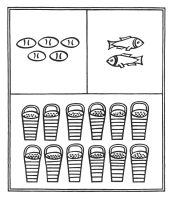 The Feeding of the 5000 (in all four Gospels):
 The Last Supper (as narrated in the Synoptic Gospels and mentioned by Paul; but very different in John's Gospel):
 "The Words of Institution" at the Christian Eucharist
