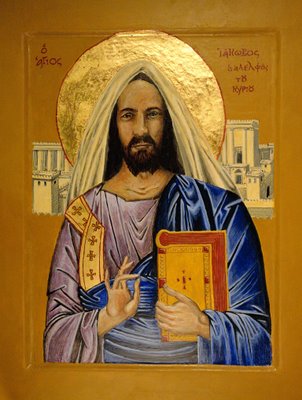
 Author and Authorship:
by Felix Just, S.J., Ph.D.
Introduction | Outlines | Authorship | Themes | Lectionary | Questions | Bibliography
| R. E. Brown (Introduction to the NT, p. 726) | J. W. Thompson (HarperCollins Bible Dictionary, p. 481) |
|
Division according to Contents/Topics:
|
|
Note: This "epistle" or "letter" does not have a standard epistolary ending, but ends quite abruptly!
Author and Authorship:| JAMES | Teaching | cf. Matthew |
| 1:2 | Be joyful in the midst of various trials | 5:11-12 |
| 1:4 | Be perfect, complete, and lack nothing | 5:48 |
| 1:5 | Ask from God, who gives generously | 7:7 |
| 1:6 | Ask in faith; do not doubt | 21:21 |
| 1:19-20 | Be slow to anger; anger does not lead to righteousness | 5:22 |
| 1:22 | Be doers of the word, not just hearers | 7:24 |
| 2:5 | God has chosen the poor as heirs of the kingdom | 5:3 |
| 2:8 | Love your neighbor as yourself (cf. Lev. 19:18) | 22:39 |
| 2:10 | Whoever fails to keep one law becomes guilty of it all | 5:19 |
| 2:13 | Judgment will be merciless for those who are not merciful | 5:7 |
| 3:1 | Not many of you should become teachers | 23:8 |
| 3:2-10 | Bridle the tongue | 12:36-37 |
| 3:12 | Can a fig tree bear olives, or a vine figs? | 7:16 |
| 3:18 | Righteousness is sown in peace for those who make peace | 5:9 |
| 4:4 | Friendship with the world is enmity toward God | 6:24 |
| 4:10 | Humble yourself before the Lord, and he will lift you up | 5:5 |
| 5:2-3 | Your wealth has rotted... your gold and silver are rusted... | 6:19-20 |
| 5:7-8 | Be patient until the coming of the Lord | 24:13 |
| 5:9a | Do not complain against others, so you may not be judged | 7:1 |
| 5:9b | The judge is standing at the door | 24:33 |
| 5:10 | Take the patience of the prophets as an example of suffering | 5:12 |
| 5:12 | Do not swear by heaven or earth... let your 'yes' be 'yes', your 'no' be 'no' | 5:34-37 |
| Sunday of the Liturgical Year | Second Reading |
| 22nd Sunday of OT – Year B | James 1:17-18, 21b-22, 27 |
| 23rd Sunday of OT – Year B | James 2:1-5 |
| 24th Sunday of OT – Year B | James 2:14-18 |
| 25th Sunday of OT – Year B | James 3:16—4:3 |
| 26th Sunday of OT – Year B | James 5:1-6 |
| 3rd Sunday of Advent – Year A | James 5:7-10 |
| Ordinary Time, Year II | First Reading |
| Week 6, Monday | James 1:1-11 |
| Week 6, Tuesday | James 1:12-18 |
| Week 6, Wednesday | James 1:19-27 |
| Week 6, Thursday | James 2:1-9 |
| Week 6, Friday | James 2:14-24, 26 |
| Week 6, Saturday | James 3:1-10 |
| Week 7, Monday | James 3:13-18 |
| Week 7, Tuesday | James 4:1-10 |
| Week 7, Wednesday | James 4:13-17 |
| Week 7, Thursday | James 5:1-6 |
| Week 7, Friday | James 5:9-12 |
| Week 7, Saturday | James 5:13-20 |
 . New York: Doubleday, 1997. – "Epistle (Letter) of James" (pp. 725-47).
 New York: Paulist, 2009.
 . New Collegeville Bible Commentary, NT 10. The Liturgical Press, 2006.
 . Eerdmans, 2004.
 . Interfaces. Michael Glazier Books / Liturgical Press, 2004.
 . Sacra Pagina. Collegeville, MN: Liturgical Press, 2003.
 . Personalities of the New Testament. Fortress Press, 1999.
 . Trinity Press International, 1997.
 . Anchor Bible, 37A. New York: Doubleday, 1995; paperback Yale, 2005.
 . Cambridge University Press, 1994.
 . Revised by Heinrich Greeven. Hermeneia Commentary. Philadelphia: Fortress, 1976.
[Please help support the Catholic-Resources website by purchasing these books through Amazon.com, using the links above. Thanks!]

Return to the HOME PAGE of Felix Just, S.J.
This page was last updated on
January 24, 2024
Copyright © 2004--2024